
The first-ever women’s ODI World Cup was played in 1973. It was held in England from June 20 to July 28 and featured seven teams. The tournament preceded the men’s ODI World Cup by two years and marked a significant milestone in women’s cricket history.
The Genesis of the 1973 Women’s Cricket World Cup
The idea of a women’s cricket world cup was brought to fruition through the collaborative efforts of English cricketer Rachael Heyhoe Flint and businessman Sir Jack Hayward. In 1971, they conceptualized the tournament, with Hayward generously contributing £40,000 to fund the event.
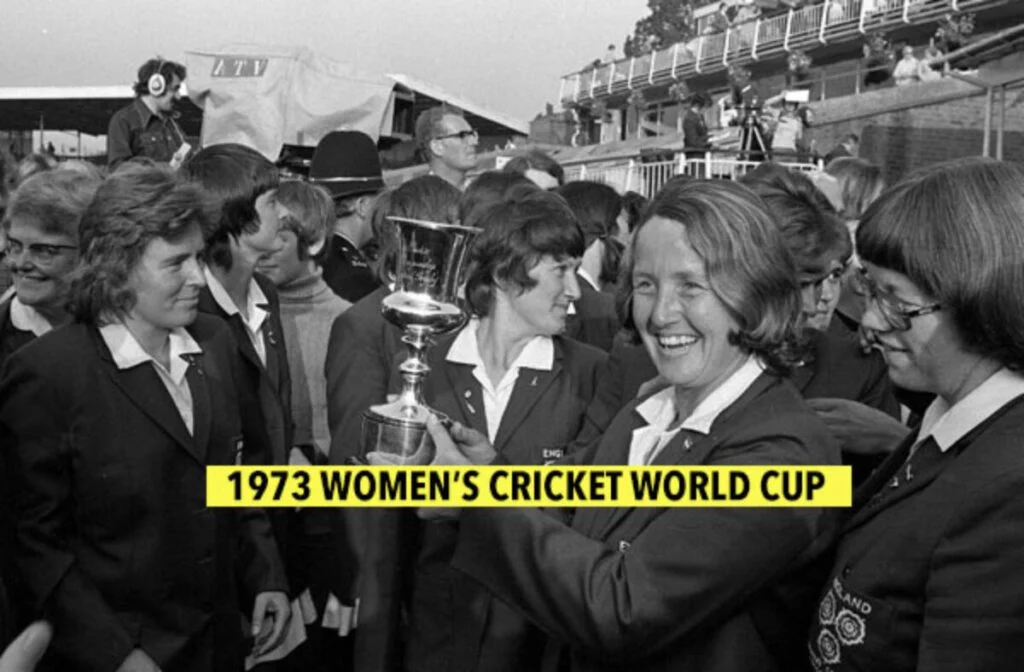
Their vision materialized in 1973 when the first Women’s Cricket World Cup was held in England from June 20 to July 28. This pioneering event was organized by the International Women’s Cricket Council and featured a 60-over format, differing from the 50-over format commonly used today.
Seven teams participated in the tournament: England, Australia, New Zealand, Jamaica, Trinidad & Tobago, an International XI, and Young England. The matches were played in a round-robin format, with each team facing the others once. The team accumulating the most points at the end of the round-robin matches would be declared the winner. This structure meant there was no official final; however, the last scheduled match between England and Australia effectively served as a de facto final, as both teams were leading the points table.
England’s Triumph and the Tournament’s Legacy
The decisive match took place at Edgbaston, Birmingham, where England faced Australia. England posted a formidable total of 279/3 in their 60 overs, with Enid Bakewell scoring a remarkable 118 runs and captain Rachael Heyhoe Flint contributing 64.
Australia struggled in their chase, managing 187/9, resulting in a 92-run victory for England. Princess Anne presented the trophy to the victorious English team, and the players were later honored with a reception at 10 Downing Street hosted by Prime Minister Edward Heath.
Enid Bakewell emerged as the tournament’s leading run-scorer, amassing 264 runs, while Rosalind Heggs of Young England claimed the most wickets, taking 12.
Conclusion
The 1973 Women’s Cricket World Cup was more than just a sporting event; it was a groundbreaking moment that elevated the status of women’s cricket. It demonstrated the potential and competitiveness of women’s cricket, inspiring future generations and leading to the establishment of regular international competitions.
The success of the tournament also paved the way for the formation of a unified West Indies women’s team, as individual Caribbean nations recognized the benefits of consolidating their talents to compete more effectively on the world stage.
In retrospect, the 1973 Women’s Cricket World Cup stands as a testament to the determination and vision of its organizers and participants. It not only provided a platform for female cricketers to showcase their skills but also laid the foundation for the growth and professionalization of women’s cricket globally.

Leave a Comment