
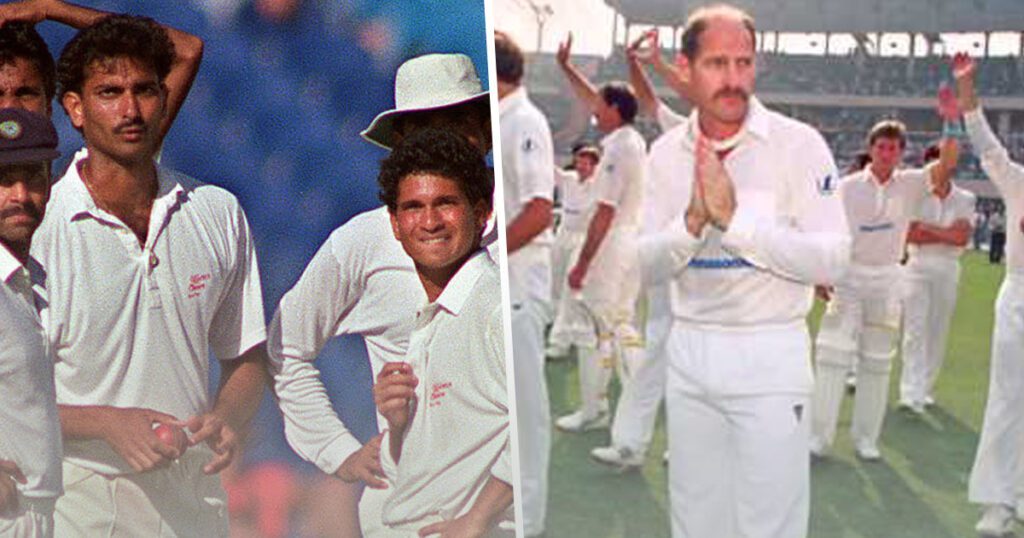
Cricket has seen several technological advancements over the years, but one of the most historic milestones occurred on 14th November 1992, during a Test match between India and South Africa. It was on this day that Sachin Tendulkar became the first cricketer in history to be given out by the third umpire. This marked the beginning of technology-assisted decision-making in cricket.
Recap of India vs South Africa 1st Test Match on 13-17 November 1992
The iconic match took place at Kingsmead, Durban, during India’s tour of South Africa. Here’s a quick look at the match scorecard:
| Innings | Team | Scorecard |
|---|---|---|
| 1st Innings | South Africa | 254 All Out |
| 1st Innings | India | 277 All Out |
| 2nd Innings | South Africa | 176/3 |
| 2nd Innings | India | Did Not Play |
How Did Sachin Get Run Out?
During India’s first innings, Sachin Tendulkar was batting and attempting a quick single. Jonty Rhodes, one of the sharpest fielders in the game, made a lightning-fast throw to the stumps. It was a very close call, and for the first time in international cricket, the field umpire referred the decision to the third umpire, Karl Liebenberg.
Using TV replays, the third umpire judged that Tendulkar was short of the crease, and he was given out. The moment was significant—not just because it involved a young Sachin—but because it was the first-ever decision made using television technology in cricket.
Who Won The Match?
The match was drawn because of the rain on 3rd day and 4th day and on the last day South Africa scored 176 with the loss of 3 wickets.
History Behind The Third Umpire System
The third umpire system was introduced in 1992 to assist on-field umpires with difficult decisions, especially run-outs and stumpings. Before this, all decisions were made solely on the field, often relying on the naked eye. The increasing availability of TV replays made it feasible to involve technology in officiating.
South Africa, being newly readmitted into the international cricketing arena, became the testing ground for this innovation. It was a forward-thinking move that laid the foundation for what we now know as the Decision Review System (DRS).
Why Sachin’s Run Out Matters For Cricketing History
While the dismissal was a personal setback for Tendulkar, it became a watershed moment for cricket as a whole. It showed that cricket was ready to embrace technology, even if it meant overturning or confirming crucial decisions. This moment eventually led to a more transparent, fair, and evidence-based system for player dismissals.
Tendulkar, even early in his career, found himself at the center of a historic moment that would influence the game’s evolution.
Quick Recap of The Incident
- Date: 14 November 1992
- Match: India vs South Africa, 1st Test at Kingsmead, Durban
- Player Dismissed: Sachin Tendulkar
- Mode of Dismissal: Run out via third umpire decision
- Third Umpire: Karl Liebenberg
- Fielder: Jonty Rhodes
- Significance: First-ever use of third umpire in cricket
Conclusion
Sachin Tendulkar being the first player given out by the third umpire is more than just a trivia fact—it symbolizes the moment when cricket stepped into the technological era. The incident is etched in the sport’s legacy, not just for who was dismissed, but for how it changed the game forever.

Leave a Comment